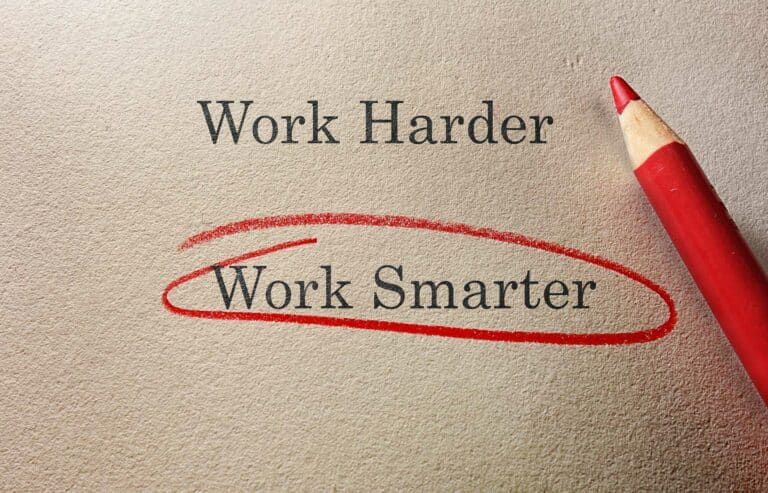
One of my strategy day clients told me during our session that stopped me in my tracks. She said, “I sat down at my desk at 9 AM with a color-coded plan. By 11 PM, I was still going, my to-do list was longer than when I started, and I honestly wanted to cry.” She’d worked all day. She barely sat down. And she still felt behind.
I hear some version of this almost every week. And every time, it breaks my heart a little.
As women in leadership, we carry this relentless pressure to look like we have every single piece of our lives perfectly synchronized. The business, the family, the health, the social life, the house that somehow stays clean (spoiler alert: mine doesn’t). And we’ve been told, over and over, that scaling a business is just a matter of doing more, pushing harder, grinding it out.
But here’s what 20 years of running businesses has taught me: that version of “success” leads to burnout, not growth. Real sustainability requires a total shift in how we think about professionalism, support, and who we are as whole people. So I’m pulling back the curtain on six lessons about sustainable business growth I learned the hard way, and trust me, they’ll save your sanity if you’re willing to hear them.
Lesson 1: Check Your Coach’s Resume (Not Just Their Instagram)
There’s a trend in the coaching world that honestly fires me up, and not in a good way. There are a lot of business coaches out there who have never actually built a business outside of their own coaching practice. They’ve maybe read about running a company. They’ve watched other people do it. But they haven’t been in the trenches themselves.
It’s like hiring someone to teach you how to play football who has never actually played football.
Before I ever became a coach, I built and ran a successful preschool business for years. I dealt with staffing, licensing inspections, cash flow, parents, payroll, all of it. So when I decided to add coaching credentials, I already had real operational experience under my belt. And I still chose the certification program from the Institute for Professional Excellence in Coaching (iPEC) because it was an 18-month, rigorous program rooted in ethics and fundamentals. It wasn’t a weekend workshop. It wasn’t a quick certification you knock out between Netflix episodes.
Before you invest in a coach or strategist, ask the tough questions. Where did they train? Was it an accredited program or a weekend seminar? And most importantly, have they actually built and run a real business? Because if they haven’t, they might give you advice that sounds great on paper but could seriously hurt your operations in practice.
You deserve guidance from someone who’s walked the walk. Don’t settle for anything less.
Lesson 2: Ditch the “Mompreneur” Label
The terms “mompreneur” and “mom boss” need to go. I know they seem harmless, even cute. But they’re limiting, and they reinforce a kind of gender bias that drives me absolutely crazy.
My husband has never once been called a “dadpreneur.” I don’t know any men who lead with parenthood as their primary professional identifier. So why do we do it to ourselves?
You are a whole woman. Motherhood, entrepreneurship, community leadership, all of that? Those are facets of who you are. Important facets, absolutely. But motherhood isn’t the whole diamond.
Here’s why this matters for your business: when you view motherhood as one facet rather than your core identity, you give yourself permission to set stronger professional boundaries. You can compartmentalize your roles in a healthy way. You can take the lead in your business without that constant undercurrent of “mom guilt” dragging down every executive decision you make.
(And before anyone comes for me, I’m a mom too. I love my kids fiercely. But I’m also a business owner, a coach, a community builder, and about twelve other things. Those identities get to coexist.)
Lesson 3: Learn How to Celebrate Other Women’s Wins
A strong business community isn’t built on how you show up during someone’s hard times. It’s built on how you react when things go right for them.
Most of us are pretty good at rallying around a friend who’s struggling. But psychologist Dr. Shelly Gable at UC Santa Barbara found something surprising: how you respond to someone’s good news is actually a better predictor of relationship quality than how you respond to the bad stuff. And I think that applies to our business friendships too.
Picture this: a friend in your networking group calls you up and says, “I just booked my biggest client ever!”
There are basically four ways you could respond:
You could go passive constructive, the classic “Oh, that’s nice” while you’re still looking at your phone. You could go passive destructive and completely hijack the conversation: “Cool, but wait until you hear what happened to me today.” You could go active destructive, which is the parade-rainer: “Wow, can you even handle that kind of project? That sounds like a lot.”
Or you could be an active constructive responder. “Oh my gosh, tell me everything! How did it happen? What’s the first thing you’re going to do?”
When you choose that last one, when you stretch the happy moment with someone, you build a bond that goes deeper than any networking event ever could. That’s the kind of collaboration over competition I want to be part of. And honestly? It’s the kind of community we’re building inside the Leading Ladies Facebook group every single day.
Lesson 4: Stop Using Your Kids as a Professional Shield
This one might ruffle some feathers. But I’ve got to say it because it matters.
Being a working mom is a reality, not an excuse for showing up unprepared. I once had a potential podcast guest call ten minutes late to a twenty-minute meeting, only to tell me she hadn’t listened to a single episode of my show because her two-year-old wasn’t sleeping. Using your children as a shield for a lack of preparation is a hot button for me. Because what it really signals is that you don’t understand your own bandwidth.
And I say this as someone who learned the hard way. Let me tell you about my Junior League blunder.
I was overextended, mentally drained, running on fumes. I had a presentation to give, and instead of having the courage to reschedule, I tried to push through. I stood at that podium with my notes a complete mess, looked out at a room full of women, and finally just said, “I can’t do this.” And I walked out.
The rumors that followed? Let’s just say “nervous breakdown” was the phrase making the rounds. It was a painful, public lesson in what happens when you force yourself forward while you’re completely out of alignment.
True professionalism isn’t about never struggling. It’s about recognizing when you’re out of balance and having the courage to pause, reschedule, or ask for help rather than showing up at half capacity.
Lesson 5: Stop Telling Yourself You “Can’t Afford” Help
High-achieving women love this line: “I can’t afford to outsource yet.” And I get it, I really do. Especially in the early years, every dollar feels precious.
But here’s what I want you to consider. You can’t afford not to get help.
Think about the mental cost of constantly switching between CEO mode and carpool-driver mode. There’s this high-stakes window in the afternoon, roughly 2:30 to 5:00 PM, where most of us are spending our energy on pickups, errands, and grocery runs. That’s prime revenue-generating time. That’s the energy you should be using for the work that actually moves your business forward.
Whether it’s using Instacart to save three hours of shopping or hiring a college student for the school run, outsourcing isn’t a luxury. It’s an investment in your capacity to lead. (And if delegation is something you’ve been struggling with, I wrote a whole post about how to start delegating like a pro that breaks it down step by step.)
And if you see someone who looks like they have it all together? I promise you they have help. Every single one of them.
(If you’ve been feeling that pull to build a business that actually works with your life instead of against it, grab my Strategic Planning Wheel. It’s free, and it’ll help you figure out where to start.)
Lesson 6: Build a Business That Doesn’t Fall Apart Without You
Your business should be able to function when you’re not there. Full stop. I got to test this in the most dramatic way possible when I came down with pneumonia during what was literally the busiest week of my year, teacher in-service week.
Because I had solid systems in place, my team handled a licensing inspection and a new school year launch without me. I was flat on my back, and the business kept running.
That didn’t happen by accident. It took three things:
First, clear job descriptions. Every person on your team needs to understand their responsibilities and their autonomy. They shouldn’t need to call you for every decision.
Second, organized shared calendars. Everyone should know what’s coming down the pike so they can step in when needed.
Third (and this is the one most people skip), early communication. The moment a challenge comes up, let your team know. Don’t just try to tough it out, because there’s a very good chance something will fail under the pressure.
I know it feels easier to just do everything yourself. Trust me, I really do know. But building that safety net isn’t just good business practice. It’s what stands between you and a very public, very stressful breakdown the next time life throws you a curveball. (I dug deeper into this idea in my post on rethinking accountability, if you want the full story.)
The Thread That Ties It All Together
Remember the client I mentioned at the beginning? The one with the color-coded plan and the 11 PM tears?
She called me a few weeks later. She’d hired a college student for afternoon pickups. She’d written actual job descriptions for her two employees instead of just hoping they’d read her mind. Small changes. Nothing dramatic.
But she told me something that stuck with me: “I finally feel like I’m running my business instead of my business running me.”
That’s what sustainable growth looks like. Not a massive overhaul. Not another course or another hustle strategy. Just one honest look at what’s not working, and the courage to change it.
If you’re ready to stop hustling and start building something sustainable, I’d love for you to join me in the Leading Ladies Facebook group. It’s a community of nearly 7,000 women entrepreneurs who get it, who celebrate each other’s wins, and who show up for the messy middle too. Because you don’t have to figure this out alone.